Cross-Sectional Study Report: LSD Seroprevalence and Management in Sirajganj, Bangladesh
Content
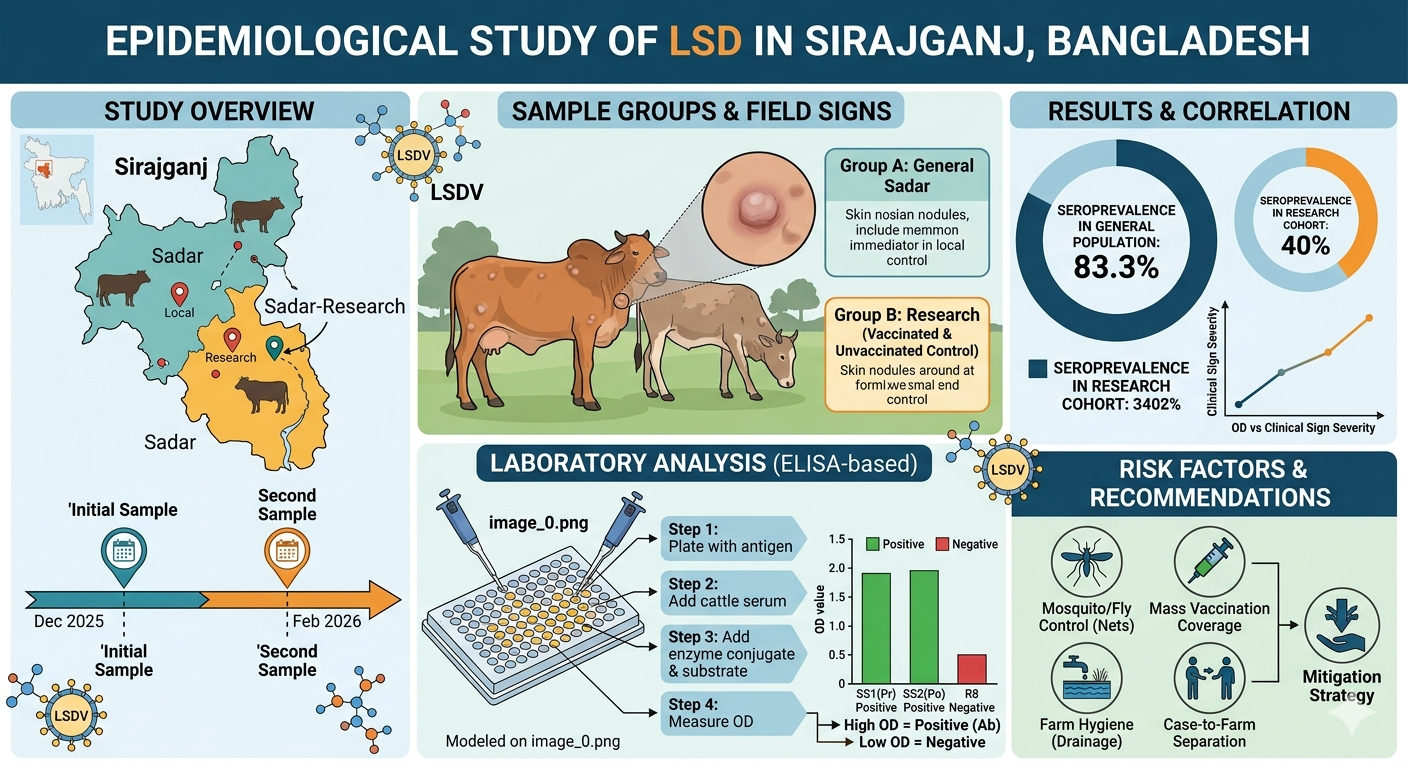
Abstract A cross-sectional assessment in Sirajganj Sadar and Sadar-Research (Dec 2025 and Feb 2026) evaluated LSD exposure in cattle using ELISA-based OD metrics and clinical field notes. Seroprevalence was high in Dec 2025 (83.3%) and more variable in Feb 2026 (40%), indicating ongoing exposure and seroconversion post-interventions; vector pressure and vaccine access remain key management gaps affecting control efforts. Introduction Lumpy Skin Disease (LSD) is a transboundary Capripoxvirus disease of cattle, primarily vectored by biting insects and supplemented by direct/indirect contact and animal movement. Since its emergence in Bangladesh in 2019, LSD imposes significant economic losses through reduced milk yield, weight loss, and calf mortality. Sirajganj, a major dairy milk-pocket, requires targeted surveillance to define baseline seroprevalence and identify livelihood-relevant control measures. Literature Review Global: LSDV is mainly transmitted by vectors (mosquitoes, biting flies, ticks, midges); clinical signs include fever and characteristic nodules; vaccination and biosecurity are central to prevention. Bangladesh: Studies in Natore, Rajshahi, Barishal show that poor farm hygiene, limited vector control, and vaccination barriers drive LSD risk; vaccination is available but cost/logistics hinder universal coverage. Private vaccination can be effective where affordable, but access remains uneven. Materials and Methods Design: Cross-sectional serology with concurrent field observations. Sample and Setting: 21 cattle samples from Sirajganj Sadar and Sirajganj Sadar-Research across two timepoints (Dec 2025, Feb 2026). Laboratory: Indirect ELISA measuring LSDV antibodies; OD values and SN% calculated relative to positive and negative controls. Interpretation: Positive if OD substantially exceeds negative-control baselines;Negative otherwise. Data: OD values, control means, SN%, sample location, date, and post/pre status. Results 5.1 Serological Summary Dec 2025 (Sadar): 6 samples; 5 Positive, 1 Negative; seroprevalence 83.3%. Feb 2026 (Research): 15 samples; 6 Positive, 9 Negative; seroprevalence 40.0%. Overall (n=21): 11 Positive, 10 Negative; seroprevalence 52.4%. 5.2 OD Distribution and Signals Notable high OD readings indicating strong exposure: SS1(Pre) 0.488, SS1(Post) 0.946, SS3(Pre) 1.462, SS3(Post) 0.478, SS-R3 1.481, SS-R4 0.936, SS-R9 1.610, SS-R11 2.180. Lower/near-threshold readings: several values around 0.06–0.22 with SN% near or below cutoffs. 5.3 Clinical Observations Field signs consistent with LSD in seropositive animals: nodules on skin, fever, nasal discharge; some animals show weight loss and reduced milk yield. Vector context: high vector activity (mosquitoes and biting flies) noted in field notes; limited netting in barns. Vaccination status: inconsistent access; private vaccination considered beneficial where affordable. Discussion The December cohort indicates endemic transmission or a recent outbreak, while the February cohort shows substantial heterogeneity in exposure, suggesting focal transmission and variable immunity. Driving factors include vector density, poor barn drainage, limited insect nets, and vaccine access constraints. Private vaccination shows potential impact but is hampered by cost and supply. Implications: need for synchronized vaccination campaigns, expansion of vector-control measures (nets, drainage improvements), and strengthened veterinary outreach to bolster surveillance and booster schedules. Conclusions LSD exposure remains a significant risk in Sirajganj Sadar with substantial seroprevalence and clinical signs; integrated management including broad vaccination, vector control, and improved biosecurity is essential to protect dairy livelihoods. Recommendations Vaccination: implement synchronized mass vaccination programs, including private sector participation with affordable vaccines and reliable cold-chain logistics. Vector control and housing: promote insect-proof netting, proper drainage, and environmental management to reduce vector breeding. Biosecurity and surveillance: strengthen quarantine of new stock, disinfect shared equipment, and expand OD-based serosurveillance for responsive booster scheduling. Veterinary services: enhance access to veterinary guidance and outbreak reporting; strengthen extension education to farmers on LSD signs and prevention. References (labeled for this report) Calistri P, et al. Lumpy skin disease epidemiological report IV: data collection and analysis. EFSA Journal. 2020. Akther S, et al. Global Burden of Lumpy Skin Disease, Outbreaks, and Future Challenges. Viruses. 2023. Khan M, et al. Prevalence and Management Strategies for LSD in Cattle: Emphasizing a Region-Based Scenario in Bangladesh. Eur J Vet Med. 2024. Uddin M, et al. Epidemiological investigation of LSD outbreaks in Bangladeshi cattle during 2019–2020. Transbound Emerg Dis. 2022. Haque M, et al. Prevalence and Management Practices of LSD in Cattle at Natore District, Bangladesh. Eur J Agric Food Sci. 2021. Parvin M, et al. Clinical Epidemiology, Pathology, and Molecular Investigation of LSD Outbreaks in Bangladesh during 2020–2021. Viruses. 2022. Pathania N, et al. Lumpy Skin Disease: Emerging Concern for Livestock Owners. Bhartiya Krishi Anusandhan Patrika. 2022. Ahmed A, et al. Lumpy Skin Disease in Cattle and Buffalo in Asian Countries: Systematic Review and Meta-Analysis. Vet Med Sci. 2025. Byadovskaya Y, et al. The changing epidemiology of LSD in Russia. Transbound Emerg Dis. 2022. Parvin M, et al. Bangladesh LSD outbreaks: including genomics (Viruses). 2022. Synthesis adaptation: where applicable, cite Bangladesh-focused epidemiology and global LSD literature to frame methods and interpretation.
Media Files
Posted On
Apr 19, 2026
Reactions
Comments
Waw
Posted on Apr 26, 2026 by Anonymous❤️❤️❤️❤️❤️❤️
Posted on Apr 26, 2026 by mdkazemali.diu@gmail.com